There's a question I get asked constantly when I talk about integrating artificial intelligence into visual production: "So you don't shoot real photography anymore?" The short answer is: I shoot more real photography than ever. AI didn't replace the camera — it gave it a working partner.
This article is about something few people are talking about yet: how to build a fashion campaign where the organic (the real shoot, the model, natural light, on-set direction) and the AI-generated don't compete with each other, but complement each other within a single visual narrative.
The mistake of thinking it's "this or that"
The public conversation about AI and creativity is almost always framed as a battle: human versus machine, real versus artificial, authentic versus generated. That dichotomy is false and, honestly, not very useful for anyone trying to build a brand.
Hybrid creative direction isn't a transition toward replacing the organic. It's an expansion of the tools available to tell a brand story more completely, more quickly, and with more layers.
Think of it this way: for decades, creative direction combined photography, video, illustration, graphic design, and collage — without anyone asking whether collage was "replacing" photography. Each tool fulfilled a specific role within the complete visual narrative. Generative AI is simply the newest tool joining that toolbox.
Does this campaign have a real idea behind it, or is it just well-produced visual noise?
What a hybrid campaign looks like in practice
Let me walk you through the real process I use when directing a campaign that combines both worlds:
Phase 1 — Concept and mood, with AI as a visual accelerator
Before any real shoot, I generate visual explorations with Midjourney to define color palette, atmosphere, composition, and emotional tone. This lets the client see the direction before committing budget, and lets me arrive on set with total clarity about what I'm trying to capture.
This phase never shows up in the final result — it's pure pre-production. But it's where 50% of the campaign's success gets defined.
Phase 2 — The organic shoot, the heart of the campaign
There's no substitute here. Real model, real on-set direction, light behaving unpredictably and beautifully, the human gesture that happens in a split second. This is the phase that gives soul and credibility to the entire campaign — the images a client will use as the hero piece across their feed, their website, their paid advertising.
Phase 3 — Extending the visual universe with generated content
Once I have the organic material, I use tools like Kling and Higgsfield to extend that visual universe: generating motion variations from still photos, creating complementary content for Stories and Reels that maintains the same visual identity as the real shoot, producing additional pieces that would've required a full second production day.
Phase 4 — Unification in post-production
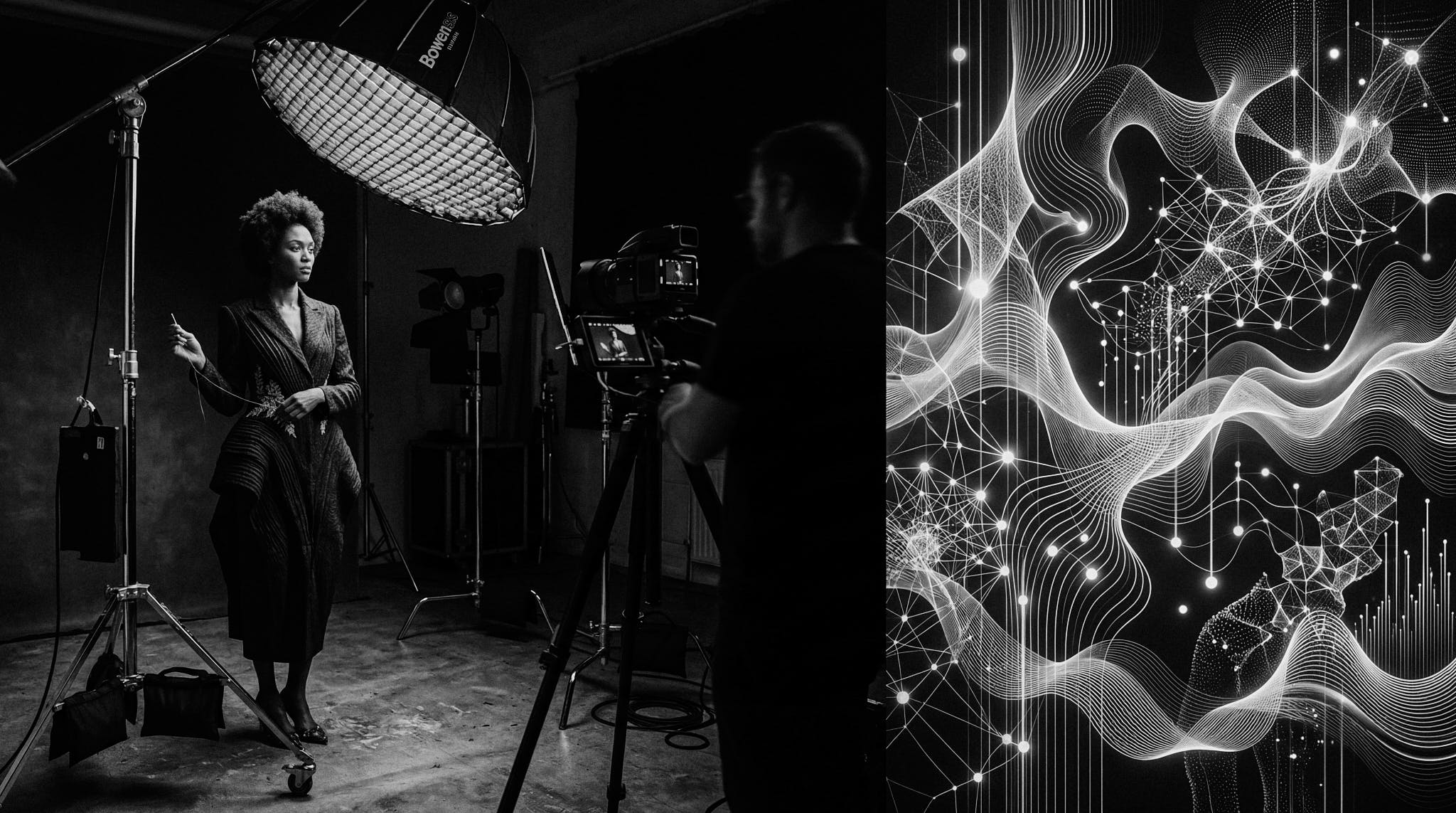
All the material — organic and generated — goes through the same color grading and art direction process so it feels like a single coherent visual voice. If executed well, no one should be able to tell which piece came from a camera and which came from a prompt, because both are serving the same narrative.
Why this is particularly powerful for fashion campaigns
Fashion has always been the industry most obsessed with visual narrative — more than product, it sells a fantasy, an identity, an aspiration. That means it needs content volume to sustain that narrative constantly, not just at collection launch.
Hybrid creative direction solves exactly that tension: it gives you the depth and authenticity of real production, combined with the speed and volume social media demands today.
Before, a brand had to choose: invest the entire budget in one big production once a quarter, or sacrifice quality for volume with constant but generic content. Hybrid direction eliminates that trade-off.
The real role of the creative director in this new landscape
Something I want to be very clear about: none of these tools work alone. Without real creative direction behind them, both traditional photography and generative AI produce mediocre results.
The creative director's role in this new context becomes, if anything, more important — not less. Now you have to:
- Maintain narrative coherence across pieces of completely different origin
- Decide what needs to be real and what can be generated without sacrificing credibility
- Direct the client's eye through a process that's more complex, not simpler
- Guarantee brand identity doesn't dilute in the mix of tools
This requires experience in both worlds — someone who understands composition, light, and model direction as much as they understand which prompt generates which type of result, and how to integrate both without the seams showing.
What's coming
We're at a hinge point in the creative industry. In five years, nobody will probably ask whether a campaign used AI or not — it'll simply be a normal part of the process, the same way using Photoshop or Premiere is today. The question that will matter is the same one it's always been: does this campaign have a real idea behind it, or is it just well-produced visual noise?
Brands that understand this before the rest will have a real advantage — not because they have access to tools others don't (all these tools are accessible to anyone), but because they'll know how to direct them with judgment before it becomes the industry standard.
Want to build a campaign that combines real production with the power of generative AI, without losing your brand's voice?
I direct hybrid campaigns for fashion and eCommerce brands, combining traditional photography and video with Midjourney, Kling, and Higgsfield — based in Medellín, Colombia, for clients across Latin America and the United States.
Let's talk about your next campaign